
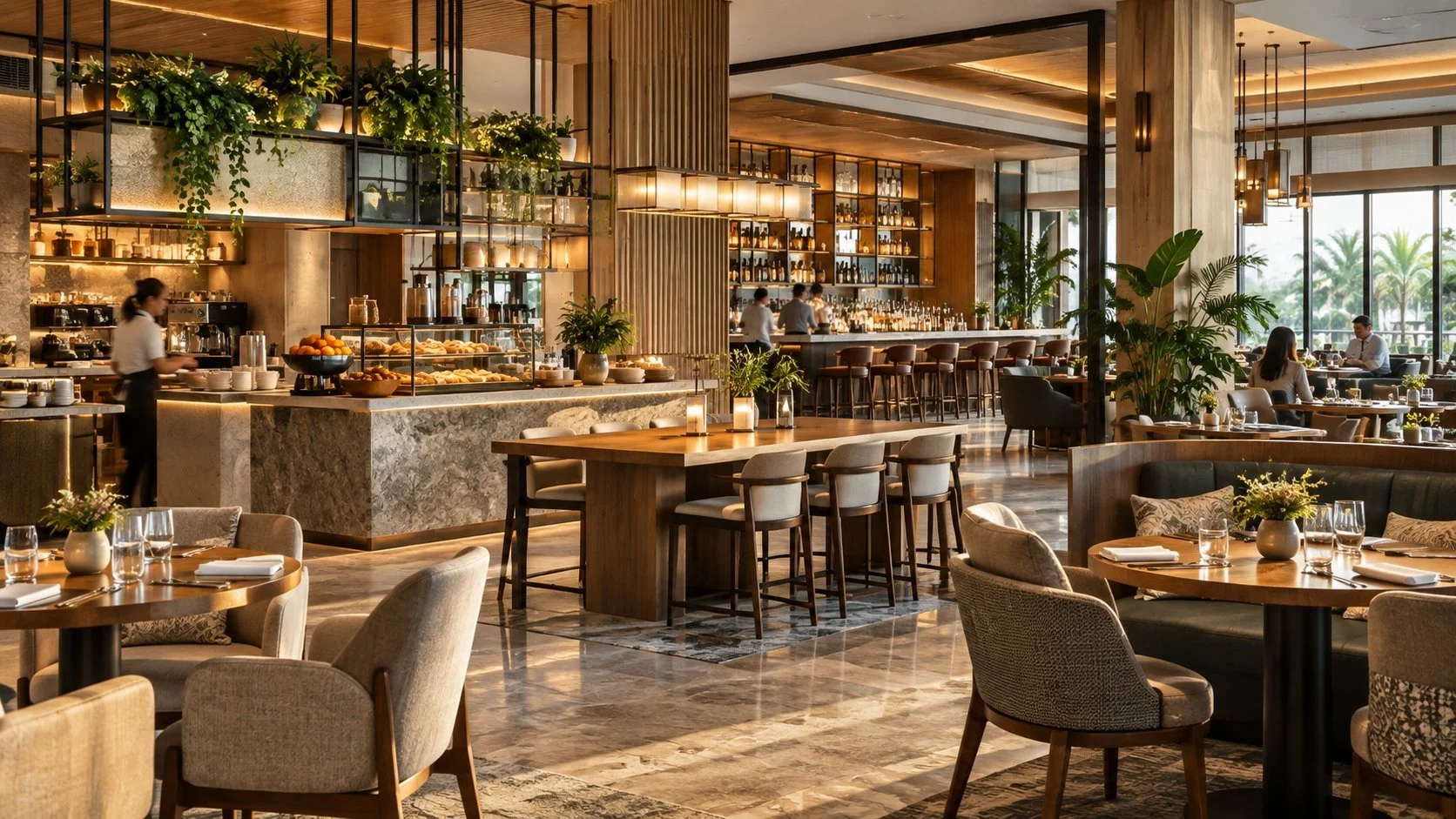
AI-generated concept image
Hotel guests have changed.
The question is whether hotel food and beverage spaces have changed with them.
A restaurant that worked perfectly five or ten years ago may still look good today. That does not necessarily mean it is operating the way today’s guest needs it to.
Breakfast behavior has shifted. Some guests want to sit down and enjoy a full breakfast. Others want coffee, something fresh and five minutes to get out the door. Business travelers may be working from the lobby. Families may be heading to an attraction. Leisure guests may not appear until later in the morning.
And breakfast still matters.
Technomic’s 2026 lodging research found that 39 percent of leisure travelers and 35 percent of business travelers consider complimentary breakfast extremely important when deciding where to stay. Technomic
Then breakfast ends.
What happens to the restaurant next?
Does the morning operation disappear?
Does the lighting change?
Does the seating feel different?
Does the room actually transition into lunch, cocktails and dinner?
At DV Studio, those questions are part of the design conversation because a successful hotel restaurant cannot be considered only as a room.
It has to be considered as an operation that changes throughout the day.
The same restaurant may have several jobs
At 7:00 in the morning, a hotel restaurant may need to move a large number of guests efficiently through breakfast.
A few hours later, the same room may need to support lunch, casual meetings, solo guests, coffee or someone opening a laptop between appointments.
Later still, the bar may become the center of activity.
By dinner, guests may expect an entirely different atmosphere.
That does not necessarily mean a hotel needs four different spaces.
It means the space should be capable of changing.
Technomic reports that lodging operators are responding to demand for both convenient options and memorable dining experiences. Forty one percent of lodging operators surveyed said they increased investment in full service restaurants to improve guest satisfaction scores. Technomic
The opportunity is not simply to add more F&B.
It is to make the F&B space you already have work harder.
Creative Director POV: Joemy Vega
First impressions still matter
When I walk into a hotel restaurant for the first time, I look for what immediately creates impact.
It could be the host stand. It could be a chandelier. It could be the bar. It depends on the floor plan and the concept.
There should be something that catches my attention and that I remember.
Then I look at how active the space feels.
Is it busy?
Does it have energy?
Where is the bar?
How does the dining room relate to it?
I am also looking closely at the materials. Flooring. Countertop stone. Millwork. Finishes.
Those decisions tell me a lot about the property and whether the space still feels relevant.
But after that first impression, I start looking at what is actually working and what is not.
That is where the real evaluation begins.
Breakfast should not control the room all day
Breakfast is one of the clearest examples of why flexibility matters.
Coffee, food displays, equipment, plates, condiments, service areas, grab and go and guest circulation all have to function efficiently in the morning.
But what happens to all of that at noon?
Technomic identifies breakfast areas, markets, micromarkets, lobby kiosks, grab and go concepts and changing dayparts among the areas lodging operators are evaluating as travel patterns and guest expectations evolve. Technomic
The 2026 Hotel Beverage Study from NielsenIQ and AHLA surveyed 5,000 U.S. hotel guests across more than 50 hotel brands. It found that 79 percent of hotel visitors consider complimentary enhancements such as breakfast and food or drink vouchers very or quite important to their hotel visits or stays. AHLA
Breakfast cannot simply disappear from the conversation.
But the breakfast setup should not permanently define the room either.
The morning operation should be designed with its second life in mind.
Creative Director POV: Joemy Vega
Treat the space like a stage
I think of this area almost like a stage.
The architecture is your backdrop.
Breakfast, lunch and dinner are different performances.
In the morning, a built in wall or millwork system might open and hold the equipment and service pieces needed for breakfast. Additional pieces can come forward to complete the setup.
When breakfast ends, those pieces can go back.
Doors can close.
A partition can move.
The breakfast operation disappears.
Then that same architectural backdrop can become something completely different later in the day.
Maybe it holds wine bottles.
Maybe it becomes a place for cheese boards or small plates.
Maybe it supports lounge or evening service.
The backdrop stays.
The performance changes.
That is much more interesting to me than designing an area that permanently looks like breakfast even when breakfast ended six hours ago.
The arrival should lead guests into the experience
Another area we evaluate carefully is arrival.
Older restaurant layouts often include a host stand, a dedicated waiting area, fixed seating and architectural barriers before the guest ever reaches the bar or dining room.
That can unintentionally stop the guest before the experience begins.
Where possible, we prefer an arrival that feels open and immediately connects the guest visually to the restaurant.
That can be particularly important when the bar is part of the energy and revenue of the space.
Technomic found that 74 percent of lodging operators view alcohol as a strategic driver of visits, sales and profitability. Its 2026 adult beverage study also found that 87 percent of hotel adult beverage sales occur across bars and lounges, banquet and catering spaces and full service restaurants. Technomic
If the bar is a strategic revenue driver, it should not feel like something guests discover only after navigating through several layers of waiting space.
Creative Director POV: Joemy Vega
Do not create a waiting room before the restaurant
On one project, we inherited a very traditional arrival sequence.
There was a host area, fixed waiting seating, a wall, then the bar and finally the dining room.
We could not change the building structure, so the solution was not demolition.
Instead, we made the host area feel as open and visually quiet as possible.
We removed the feeling of a permanent waiting room and treated the remaining built in element more like an architectural feature.
I think about it almost like a luxury handbag displayed in a beautiful white space.
There is one intentional object, but the space around it is allowed to breathe.
The host stand became a smaller part of the composition so when guests entered, they could experience the restaurant, bar and dining room together.
We wanted to greet them and naturally pull them forward.
Especially toward the bar.
Start with what is not working
When a hotel restaurant needs a refresh, it is easy for the conversation to begin with finishes.
New flooring.
New furniture.
New paint.
New lighting fixtures.
Those things matter.
But they should not be the first question.
The first question should be:
What is not working?
Where is the operation slowing down?
Where are employees walking too far?
Where are guests hesitating?
Where are queues forming?
What is taking up space without producing enough value?
What happens when breakfast closes?
How does the bar connect to the rest of the restaurant?
Which seating gets used and which seating does not?
Design should respond to those answers.
Creative Director POV: Joemy Vega
Do not gut a restaurant just because it needs help
When I evaluate an existing restaurant, the first thing I want to understand is what is not working operationally.
That is what we fix first.
Then we look at everything around it and ask what we can improve, add, remove, enhance or make disappear.
I do not automatically think, gut the whole place and start again.
Maybe the space needs more lighting in one area.
Maybe a different paint color changes the emphasis.
Maybe the millwork needs to perform differently.
Maybe the circulation needs to be corrected.
Maybe an element is substantial and worth keeping, but everything around it needs to be reconsidered.
Think about taking most of the body of the restaurant and giving it a really good makeover.
Keep what works.
Fix what does not.
Then spend the money where it is actually going to make a difference.
F&B deserves investment, but the investment should be strategic
There is a financial case for taking hotel F&B seriously.
CBRE analyzed monthly operating statements from 866 hotels during the first six months of 2025. F&B revenue per occupied room increased 3.8 percent, compared with a 3.0 percent increase in total hotel revenue for the same properties. CBRE also reported particularly strong F&B revenue growth among luxury and resort hotels. CBRE Hotels Research
That does not mean every hotel restaurant needs a major capital project.
It means F&B should be evaluated as an asset capable of producing revenue, strengthening the guest experience and contributing to the identity of the property.
Investment could mean improving service points.
Reworking arrival.
Increasing visibility to the bar.
Creating a better seating mix.
Adding lighting scenes.
Designing millwork that transitions between dayparts.
Reclaiming space that is underused.
Or allowing one area to perform several jobs throughout the day.
The right scope comes from understanding the problem first.
The restaurant you need may already exist inside the restaurant you have
Sometimes a complete repositioning is absolutely the right answer.
Sometimes the concept itself has run its course.
But that decision should come after understanding what already exists.
At DV Studio, our approach is operations first, then design.
We want to understand how the restaurant performs, how the guest experiences it, where friction occurs and where there is unrealized opportunity before determining how much needs to change.
Because sometimes the smartest renovation is not about starting over.
It is about seeing the existing space differently.
And designing it for the way guests actually use it today.
Frequently Asked Questions
Does a hotel restaurant need a full remodel to improve performance?
Not necessarily. An operational review may identify targeted opportunities involving circulation, seating, service points, millwork, lighting, arrival or daypart transitions that can improve the guest experience without rebuilding the entire restaurant.
How can a hotel restaurant transition from breakfast to dinner?
Flexible millwork, concealed service areas, movable partitions, lighting scenes, adaptable furniture layouts and multipurpose service points can allow one space to support several dayparts.
What should a hotel evaluate before renovating its restaurant?
Start with guest behavior, employee movement, circulation, seating utilization, service points, breakfast operations, the relationship between the bar and dining room and how the space performs between meal periods.
Why does daypart flexibility matter in hotel F&B design?
Because one restaurant may need to support breakfast, lunch, meetings, solo travelers, cocktails, dinner and groups within the same day. Designing for those transitions can help existing square footage work harder.
Thinking about a hotel F&B refresh?
DV Studio works with hotel and resort teams to evaluate existing restaurants, bars, markets and F&B spaces before defining renovation scope.
We look at operations, circulation, guest experience, seating, service points, daypart transitions and the existing design to determine what should stay, what should change and where investment can have the greatest impact.
Have an existing hotel F&B space you are evaluating? Let’s look at it together.
Explore our hospitality interior design services or contact DV Studio to discuss your property.